Welcome to Enneagram 101
I’m so glad you’re interested in learning more about the Enneagram! It’s such a useful tool for writers, both in learning how best to structure their business and how to write stronger characters that readers remember for years to come.
Start with these videos on the basics of the Enneagram, then explore more about the nine types below.


Enneagram 101
If you’re not familiar with the basics of what the Enneagram is, how it was developed, and why it’s useful, here’s your crash course.
Table of Contents:
Introduction: Enneagram Basics
What is the Enneagram?
The Enneagram is a personality framework that is unlike any other because of what it measures. People often ask me how it corresponds to MBTI types, and the answer is: it doesn’t. It’s not measuring the same thing at all. It’s also not measuring the same thing as DISC, Big 5, CliftonStrengths, Colors, or any other test (some of which are developed solely as marketing lead magnets).
The Enneagram sorts people into nine distinct types, sometimes called “styles” or “lenses.” The criteria for sorting is simple: a person’s core fear and core desire.
Fear and desire are the basis of the thing we call “motivation.” The word “motivation” is derived from the same root as the word “move.” Motivation moves us. What we fear and desire most determines where we put our attention and subsequently what we do, think, and feel.
You might see how this is incredibly useful to know as a writer, particularly if you write fiction. How do you get your characters from one place to the next? What is the right motivation to move them where you want them to go?
This doesn’t only apply to physically moving a character from one setting to the next. When we talk about motivation, we’re also talking about moving someone emotionally and intellectually.
In Enneagram-speak, the results of motivation are often referred to as “cognitive, emotional, and behavioral” patterns or “schema.”
The Enneagram describes how we are motivated in three ways: thinking, feeling, and doing.
Where your fear and desire go, so does your attention.
My favorite description of what the Enneagram actually is comes from a teeny-tiny book that packs a punch, called The Essential Enneagram by David Daniels, MD, and Virginia Price, PhD:
The Enneagram is a powerful and dynamic personality system that describes nine distinct and fundamentally different patterns of thinking, feeling, and acting.
Of note here is the word “patterns.” Certain patterns of thinking, feeling, and behaving are more commonly seen in certain types BUT not everyone within a particular type will have all identical patterns. AND there is crossover in these patterns between the types, meaning when you observe a particular pattern of behavior in someone, you cannot with certainty guess their type. That would require you to look inside their mind to see what thoughts and emotions are driving the action. It would also require that you observe those patterns for an extended period of time to find a pattern among the patterns to ensure you’re not observing a one-off expression.
Price and Daniels go on to explain:
Each of the nine patterns is based on an explicit perceptual filter and associated driving emotional energy.
The concept of note in this is the idea of a perceptual filter.
What is that, and why would we have it?
Consider this: there is a massive amount of information coming at you all the time. This information includes visual (sight), auditory (hearing), olfactory (smell), tactile (touch), gustatory (taste), and the often overlooked vestibular (movement) and proprioceptive (body awareness) information.
Now imagine you’re speaking with another human being. For auditory information alone, you’re processing their tone, volume, pacing, and pitch.
Most of us do this without even “thinking” about it; that is, unless there’s ambiguity or conflicting information between those auditory inputs, we follow along easily (obviously there is some variance in this depending on your auditory processing capacity).
How we can function in the sea of inputs from a single interpersonal interaction is because our brains are incredibly adept at filtering out irrelevant information from all of our senses.
But what data is relevant and what is irrelevant? That will depend largely on your core fear and core desire.
Two people of different Enneagram types, when presented with all the same heaps of sensory information in a situation, will filter out different bits of data. Consequently, they will pay attention to different bits of data.
In effect, those two people, who could be standing side by side and receiving virtually identical raw information from a source, will have a totally different experience of the interaction based on what their brains are sorting as relevant and irrelevant.
For instance, let’s say Person 1 fears nothing more than being worthless and valueless (the fear of the Enneagram Type 3-Achiever) while Person 2 fears nothing more than being separated and cut off from their wholeness of the group and the universe (the fear of the Enneagram Type 9-Peacemaker).
These two people are sitting next to each other at a company meeting. The boss stands up, his chest out, and announces that bonuses will now be awarded each month based on sales numbers, and those sales numbers will be posted publicly.
Ignore the fact that this sounds like a cutthroat if not sadistic boss, and consider what information each of our two people is absorbing. That is, what do they find relevant to avoiding their core fear?
Person 1 (Type 3 - Achiever) is probably thinking (either consciously or subconsciously) something like this: I have to be at the top of the list each week. I can’t let these people show me up. Any week I don’t win is a failure on my part. I finally have an opportunity to be recognized as the best salesperson in this office.
Or, if they’re a little less self-assured, they might be thinking, Oh no. I’m going to have to step up my game so I don’t fail at this. I can’t entertain the possibility of being last for even one week. I’ll do whatever it takes to be at the top.
In both of the situations, you see a focus of attention on win vs. lose, which is also success vs. failure, and more subtly, valuable vs. valueless, which points directly back to the core fear and desire of the type.
Meanwhile, Person 2 (Type 9-Peacemaker) will be focusing their attention on different information from the boss’s announcement. They might be thinking (consciously or subconsciously), This is going to tear our office apart. Why does everything have to be a competition? We work so much better when we work together. Now I have to find a way to keep from losing, so I don’t get fired, but not do so well that I step on other people’s toes. Especially on Person 1. They wouldn’t like that, and I can tell being first means a lot to them.
Because Peacemakers are afraid of conflict, their mind is sorting out anything that doesn’t relate to that (the status of the leaderboard, for instance) and assigning relevancy to anything that could lead toward a clash. This Nine is clearly torn between their need to maintain peace and their desire to keep their job, a very human dilemma. What will they choose if they can only pick one? That depends on a great deal of things, and it sounds like an interesting scene to write.
Key Idea: Our attention follows our fear.
If you’ve ever encountered a snake while you were out hiking, and you’re not one of those weirdos who’s really into snakes and is like, “COOL!” and wants to pick it up, then you know that the snake gets your attention for as long as it is within striking distance. And maybe longer. (“Is it following us? What if there’s another one around? Do you think it has a nest and there are a bunch of baby snakes we need to watch out for?” And now every sound in the bushes is obviously another snake.)
Beneath all the razzle-dazzle of being a mostly functioning adult, our core fear is drawing our attention like the snake on the trail.
That is, until we start to notice that it’s doing that.
Once we bring awareness our fear patterns and learn about that particular “snake” (maybe it’s not venomous and hangs out in predictable spots, so we only need to be on the lookout when we’re in that territory), then it stops taking up all of our attention, which we can direct toward building a wonderful life for ourselves.
This is how you use the Enneagram. You begin by identifying your fear, learning about your desire, and seeing how the patterns of attention arising from those may not be getting you to the place you dream of being.
And then you notice, notice, notice. For the rest of your life.
How does this apply to writing?
The trick about the Enneagram is that it applies to all decisions we make. This includes the many decisions in our writing life.
Here are some of the many creative decisions you’ll have to make:
What decisions will my protagonist make?
What genre of book do I want to write?
Should I write stand-alones or series?
What tropes should I include?
What themes should I write to?
How many words will I aim to write?
And here are some of the many business decisions you’ll have to make:
Who do I market to?
How do I structure my business?
What platforms will I publish on?
Do I try to find an agent or publish independently?
How many books will I put on my production calendar this year?
How many hours will I work each week?
How many days per week will I work?
Who will I collaborate with?
Your core motivation, along with where you are in your development of the type, has likely been guiding your decisions without you realizing it. Sometimes those subconscious decisions made by our motivation limit us and are in response to outsized fear. In learning to notice these decision points (that often don’t even feel like decisions because we make them so quickly), we can better assess where our fear is outsized and keeping us from what we truly want, or if we’re following the truest form of our core desire.
By understanding why we make the kinds of decisions we make, and by reclaiming control over those decisions, we build a writing life we meant to build, and one that will leave us feeling satisfied and fulfilled along the winding road.
Section 1: The Nine Types
Why we learn all 9 types
I’ve observed an impulse in myself and others, at least initially, to hyperfocus on our dominant type when we first learn it. That’s totally normal as well as helpful to the learning process. Once we get a taste of being seen in the intimate way that the Enneagram is known for, it’s normal to want more. That desire for greater understanding of ourselves is what leads to learning, which leads to a deeper connection to self, which leads to healthy growth.
However, there is a limit to how much we can learn about ourselves when we only learn about our specific type, often described as a “lens” through which we view the world. It’s like trying to learn about the aspects of the water we’ve been swimming in our whole life merely by swimming more. The thought process might metaphorically look like this:
I’m in water? I’m in water! Holy shit! Wait, what is water? What are the properties of it? How does it work? Why did I never notice it before? What is all this stuff floating in it? What else lives here?
None of this, however, helps us understand the alternatives to the water we swim in. And without contemplating the alternatives, we’ll miss out on a wealth of questions about our own habitat that we don’t even know to ask. We won’t know that there exist places that aren’t wet, so we won’t know to ask about the wetness aspect of the water.
What happens in our brain when we learn about the lenses through which other people view the world is that we are able to see our own defaults more clearly. There are a set of thoughts, feelings, and behaviors that are so fundamental to our own operating system that we cannot see them and assume everyone else functions with the same basic operating system. They don’t. This is what causes so much frustration when trying to understand why other people aren’t doing what you would do in a situation. Their basic operating procedures are different from yours.
A major turning point of this work is when you truly see for the first time how fundamentally different someone of a different type is from you. In seeing that they are a particular way that is not necessarily better or worse than other ways, you are then able to see that you are a certain way that is not necessarily better or worse than other ways.
When this happens, it becomes much more obvious that our thoughts and beliefs are just patterns we’ve picked up throughout our life, our emotions are not the only possible legitimate way we could feel about a situation, and our actions that make so much sense to us are not the only way to proceed to achieve our aims.
In short, a new world of fresh options opens up to us.
This is why we want to learn about all 9 types. Learning about yourself is certainly useful, but learning about how 8/9ths of the population are living with totally different patterns from you and are therefore experiencing fundamentally different realities can really be a WTF moment. And also an opportunity for a windfall of revelations.
Not to mention it’ll make writing characters of different types much, much easier.
If you’ve ever wondered, Why won’t she just do the responsible thing? or Why won’t he just lighten up? then it’s time to learn about the other eight Enneagram types. That’s where the answers lie.
She won’t do the “responsible” thing because her attentional patterns draw her toward the thing that will put her in the power position, and those two things are not always the same.
Your partner won’t “lighten up” because his attentional patterns lead him to worry about y’all ending up in a tough spot where you split up and he’s left alone and without support.
So, if you know about your type, that’s a start. But you haven’t even begun to unwrap the gifts of the Enneagram until you’ve learned about all nine types.
What are the types?
You already have a wealth of information on your Enneagram type from the 23-page iEQ9 Report, so if you haven’t read through that in full, I encourage you to do so. You’ll also notice that page 2 of the report includes a brief description of each of the types. That’s certainly a start, but I’d like to give you a little more to grab onto for each. It can be helpful to read descriptions of each type from multiple sources, too, because you’ll find little nuggets here and there that help better anchor you to the essence of that type. It can be especially difficult to understand types that we have very little of in us, too. (Yes, they use different names for each type on the iEQ9 than I’ll be using in this course. I don’t like a lot of the names they use, and this is my course, so I’m doing it the way I want and using the standard RHETI, or Riso-Hudson, names for each type.)

You see that every type has a descriptor associated with it that helps us remember the nature of that type. For instance, the Achiever, known for efficiency and getting the most out of every opportunity that comes along, is sometimes called the Performer in other models or the Competitive Achiever in the Integrative Enneagram’s model. When you learn more about Type 3s, these descriptors make a lot more sense, but on face value, you might associate the “Performer” label with being artsy and confuse it with the Type 4, the Individualist (sometimes called the Romantic or Intense Creative) who is usually stereotyped as being the “tortured artist.” Totally different energy.
That’s why I like the RHETI descriptors, and you can get comfortable with them because they’re what I use in my books, and what I’ll be using in this course.
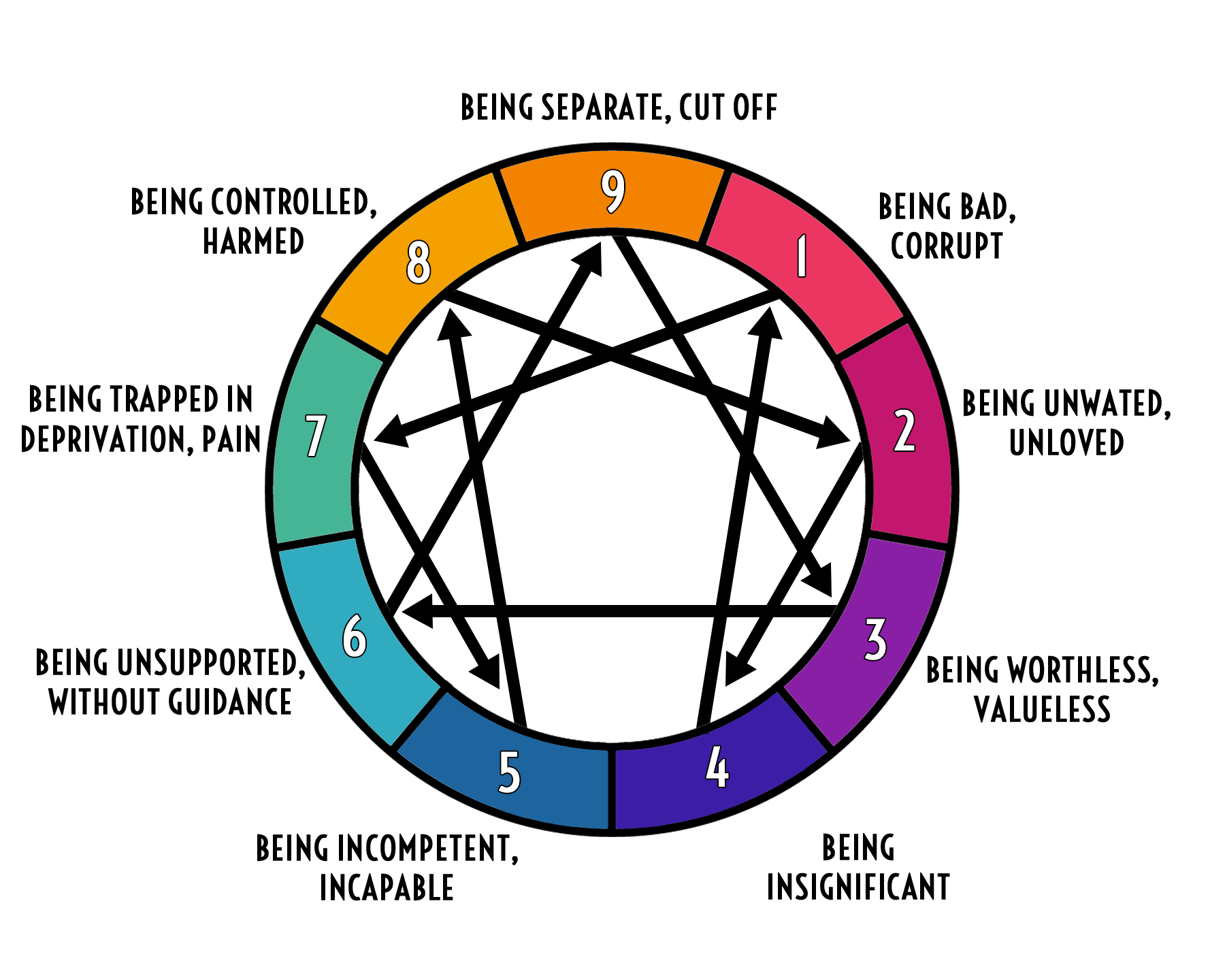
Below are the core fears of the types.
And here are the core desires:
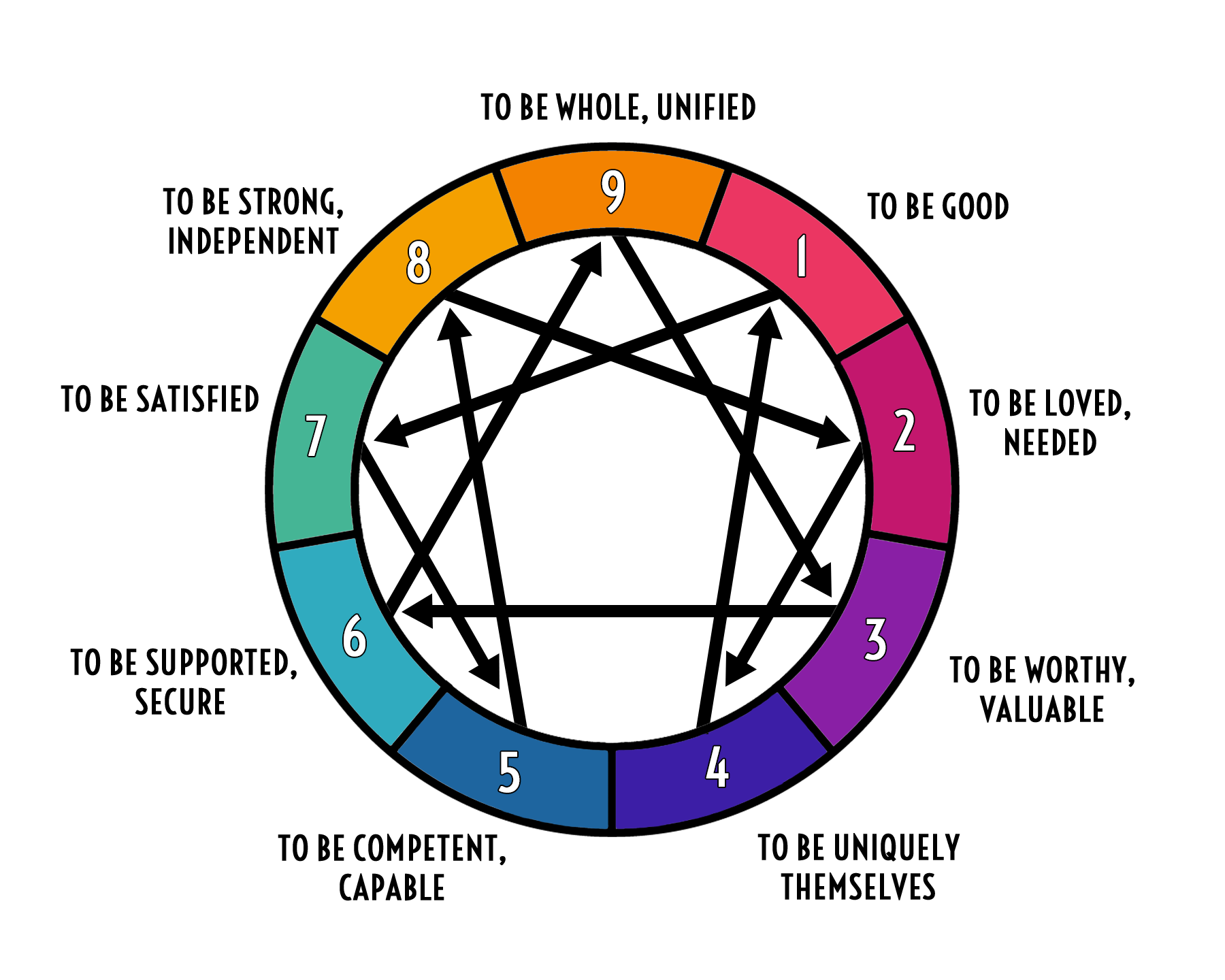
You’ll notice that the fear and desire are two sides of the same coin. For instance, a Four wants to feel significant (essentially, they want to understand the meaning of their life) and fears lacking significance (their life being meaningless). Similarly, the Eight wants to feel powerful and be in control, and they fear being powerless and controlled by others.
The core motivations are a great place to start, and it’s important to remember that our type is not determined by our behaviors but rather our motivations. That being said, there are clusters of patterns that tend to form around each type that result from those core motivations, and reading more about those can help us visualize each type more fully. Here are brief descriptions of each (pulled from Reclaim Your Author Career):
It can also help to get a sense of the types by attaching them to well-known celebrities and characters of that type. Sometimes seeing a few personalities grouped together can help us draw a line of commonality between them. So here are some celebrities and fictional characters of each type (keep in mind these are best guesses):
1-The Reformer: Nelson Mandela, Atticus Finch, Hermione Granger, Tina Fey, Michelle Obama, Thanos, Osama bin Laden
2-The Helper: Bishop Desmond Tutu, Samwise Gamgee, Molly Weasley, Dolly Parton
3-The Achiever: Oprah Winfrey, Taylor Swift, Sansa Stark, Draco Malfoy, Don Draper, OJ Simpson
4-The Individualist: Edgar Allan Poe, Anne Rice, Jay Gatsby, Luna Lovegood, Moira Rose, Holden Caulfield
5-The Investigator: Albert Einstein, Sherlock Holmes, Agatha Christie, Severus Snape, James Joyce, Hannibal Lecter
6-The Loyalist: J.R.R. Tolkien, Princess Diana, Malcolm X, Mulan, Dwight Schrute, Alex Jones, Wormtongue
7-The Enthusiast: Galileo, Indiana Jones, Amelia Earhart, Joe Biden, Timothy Leary, Paris Hilton, Peter Pan
8-The Challenger: Franklin D. Roosevelt, Martin Luther King, Jr., Sirius Black, Serena Williams, Amy Pohler, Ernest Hemingway, Saddam Hussein
9-The Peacemaker: Abraham Lincoln, Queen Elizabeth II, Harry Potter, Barack Obama, Audrey Hepburn, George Lucas, Norman Bates
As you can see, there’s a wide variety for each type, but there’s also a thread of commonality between them. Prior to learning about the Enneagram, you might not have paired Galileo and Paris Hilton together for any reason, but once you learn about the underlying motivations of the Seven, they both fit the bill.
Our type in writing and marketing
You’re probably wondering how this applies to your writing and marketing, and that’s a great question, since this is the Liberated Writer.
Our core fear decides where our attention goes. Our attention determines what options and opportunities we are able to see available in our writing and marketing. Our perceived available options determine our outlook on the industry. Our outlook on the industry determines whether we remain motivated to continue writing or whether we lose our motivation and spend our time in other places instead.
That can be distilled down to this:
Fear ➞ Attention ➞ Options/Opportunities ➞ Outlook ➞ Continued motivation to write
That means that if our fear gets too big or goes unexamined, our attention narrows, we see fewer options and opportunities, our outlook becomes pessimistic or cynical, and we lose motivation to write our stories.
Essentially this:
Fear ➞ attentional blinders ➞ few/no opportunities/options ➞ negative outlook ➞ writing struggles
We can adjust the whole flow by simply examining the core fear, learning about how it’s impacting our attention, and slowly lessening our fear’s grip on us through curiosity and by running small experiments.
Here are some examples of how fear can demotivate each type:
Ones: Fear of being bad (criticism) ➞ over criticizing your writing as you’re writing it. Exhausting.
Twos: Fear of being unloved ➞ feeling unloveable any time you’re not helping others (including writing time)
Threes: Fear of lacking value ➞ believing the market is too crowded for you to ever get the attention you want
Fours: Fear of being insignificant ➞ everything you write feels unoriginal and uninspired
Fives: Fear of being incompetent ➞ feeling like you don’t know enough yet to write the book (and may never)
Sixes: Fear of being without guidance ➞ doubting and second-guessing every writing decision
Sevens: Fear of deprivation ➞ not committing to a project long enough to enjoy the results
Eights: Fear of being controlled ➞ too much on your plate because you won’t let others help you
Nines: Fear of being separated ➞ telling yourself your writing doesn’t matter that much anyway
You may recognize that writing struggle of your type but not fully understand how you got from that fear to that outcome. That’s okay! You’re free to either think about it, breaking down the process step by step, or you can just ask me and I can explain. I think there’s some value to trying to decode it yourself, though.
As you embark on your Enneagram journey, you get to explore the ways your core fear shows up, shrink it down to a manageable size, loosen its hold on you, and almost like magic, you will feel your motivation to write return. It can be wonderfully freeing to trust the process.
Main takeaways
Everyone has a dominant type
Your type is defined by your core fear and core desire (collectively: core motivation)
Predictable patterns of thinking, feeling, and acting arise from your core fear (and desire)
Learning about the other eight types is a great way to better understand your own type.
To increase our visible options, improve our outlook, and increase our motivation, we must address our core fear.
-
Morally gray areas are uncomfortable, but thankfully you’re an expert sorter of all things into right and wrong. You’ve been called a perfectionist frequently in your life, but it’s not your fault you have high standards for everything. How else would things get done the right way? Sometimes you’re so angry at the injustices of the world that you want to scream, but there’s not an appropriate time or place for it, so you’ll choke it down and work harder on trying to fix what’s broken. There are days when your inner critic is so loud that you want to give up, agree with the jerk, and crawl under the covers. But you don’t. At least not permanently. You have a vision of a better world, and it’s your mission to move yourself and others toward it, whether you enjoy it or not. You spend a lot of your time thinking of the best way to live your life while causing the least amount of harm. Your friends come to you for wisdom and rely on you for your integrity.
-
You don’t understand how the world can be so harsh. When those around you need help, you’re the first one to offer it. Sometimes even when they don’t need help, you’re the first one to offer it. After all, what good are you if you’re not helping? A refusal of your help can feel like a rejection of you as a person, so you build a life full of people who need you. If someone asks you what you need, though, the answer is always “Nothing, I’m good.” That is, until you aren’t anymore. Then you find yourself looking around and wondering why no one anticipates your needs like you do theirs. You don’t want to be bitter, but you can’t help it sometimes. They shouldn’t have to ask what you need, they should just know, like you did with them. You spend much of your life anticipating the needs of others, and your sensitive nature makes you incredibly talented at it. You’re frequently called nurturing. Your friends know that you’ll always be there when they need a shoulder to cry on and a warm meal.
-
Productivity comes naturally to you. You have a gift for anticipating the desires of those around you, especially whom they would like you to be, and you understand that fulfilling those desires is the easiest way to achievement. You’ve been called charismatic before. You’ve also been called a chameleon. Sometimes playing the part becomes exhausting, like a never-ending job interview, but when you think about all you have left to accomplish, you don’t see another way to the finish line. Whatever you choose to do in life, you earn high marks, awards, and bonuses... otherwise, you don’t do it. You have no problem promising to deliver on something before you know how you’ll get it done, because you trust in your work ethic and savvy to find a way to at least meet the bare minimum of what’s required to please others. Your friends are in awe of what you’ve accomplished, and when they need help figuring out a path forward, they seek your counsel.
-
The world is a messy and complicated place, and those who believe they understand it are missing the point. You didn’t choose to be on planet Earth, but now that you’re here, perhaps you should explore your place in the chaos. You’ve been called artsy or overemotional for most of your life, but that’s just a by- product of your search for your true self. You feel emotions, especially the darker ones, strongly, and you channel that in your various fantasies. You like things messy because chaos seems to shake out the truths and expose the frauds around you. Order is a coping mechanism for other people, but it’s not the true way of the universe. Nothing can truly be understood, not even you. You’re usually the oddball of the group, and you prefer friends who don’t act like they have it all together. When one of those friends feels down, they trust they can share the dark parts of their life with you without judgment.
-
You wish you had more time on this earth for your research. When you find a topic interesting, you naturally fall headfirst into it and become an expert without thinking twice. You live your life rationally, trying to correct for the occasional emotions you feel that could bias your logical thinking. You’re a problem solver, because how else would you use your time? You’ve been called private or emotionally unavailable more than once and by many people. While you enjoy observing others, the demands of interpersonal relationships can feel like they’re draining the life from you, and you need that energy for your learning and research. When you do get started talking about one of your pet topics, though, you can happily go on for hours. Your friends come to you when they need information or an objective opinion from someone who won’t gossip about it after.
-
The world is a scary place, and the best way to get through it is by making friends. You often sort people into allies and enemies, and you have a sixth sense for threats. When you find people you trust, you give them your complete loyalty... until they show signs of a possible betrayal, and then they’re cut off. You’re a responsible person by nature, understanding that adhering to the rules and expectations placed on you is the easiest way to keep a low profile and avoid a target on your back. You’ve been called anxious more than once in your life, and those people don’t know the half of it. You wish everyone could approach life more cooperatively rather than scheming and exercising rugged individual‐ ism. Things work better when people work together. But you know that never lasts. Someone always betrays the group, and when they do, you’ve usually seen it coming. You struggle to trust authority even as you look to authority figures to protect you. Your friends know that you have their back and will be there to wholeheartedly cheer them on.
-
There are so many enjoyable experiences in this world, why hold yourself back? The world is full of possibilities, and you’re not going to let anyone stop you from pursuing them as you will. The people you spend the most time around are those willing to come along on your adventures, but almost all of them seem to drop off eventually. You’ve been called scattered or avoidant more than once, and your ability to simply “move on” from an unpleasant situation has left friends with hurt feelings in your wake. What are you supposed to do when your mind goes a mile a minute and there are still exciting places and foods to explore in this one life—sit still? Just because you prefer to focus on the positive doesn’t mean nothing ever gets you down. But when it does, you pop right back up quickly. Too much to do to stay low for long. Your friends know you’re always up for an adventure, and they reach out to you when they need to get away from their troubles for a little while.
-
There’s no place in your life for people who try to hold you back. You know what you want, and you’re doing to get it. God help anyone who tries to stop you. Life is a battle that you intend to win, and your weapons are a strong will, honesty, and fearlessness. Whether you mean to or not, you end up in leadership positions, but you can’t abide submitting to the authority of someone else, so that suits you just fine. You’re not for everyone, and that’s okay. You know that plenty of people find you a little scary, but that’s their problem, not yours. When you do find your people, you take them on as your responsibility and will defend their interests as you would your own. You’re reluctant to show vulnerability, since it’s an invitation for someone to hurt you. When unjust power has taken hold somewhere, you’re the first to challenge it. Your friends know you have their back in a fight and are put at ease by the fact that you say what you mean and mean what you say.
-
The universe is one complete body, and you wish everyone would stop trying to separate it out into bits and pieces. You don’t understand why everyone is always at odds with each other when they’re more the same than different. You easily find common ground with yourself and those around you, and when the other person tries to create conflict, you’d much rather acquiesce than engage. You enjoy the comforts of life, maybe a little too much. How else are you supposed to preserve your inner peace but to withdraw occasionally from reality? You say yes to things only to realize once you’re committed that you really meant no. You’ve been accused of being passive-aggressive more than once. You can see situations from every point of view, which makes you a fantastic mediator and terrible at deciding where the next family vacation should be. Your friends come to you when they need calm from the storm or a nonjudgmental friend to listen to their woes.
More Resources for Mastery
There is so much more to explore with the Enneagram. Check out these resources to see which one aligns with your interests and goals.
Click an image to learn more.
Books
Reclaim Your Author Career


Sustain Your Author Career

Write Iconic Characters
Courses

The Liberated Writer 5-Week Course
Heroes of the Enneagram (self-paced)
Writing Iconic 5-Star Endings (self-paced)

Villains of the Enneagram (self-paced)
Free videos and podast

What if? For Authors podcast

Liberated Writer on YouTube